
How Smarter Inspections Support Capital Planning in Facilities Management
Across industries, facilities leaders are being asked to stretch shrinking capital budgets even as costs surge. An APPA survey of higher-ed facilities leaders found many are coping with flatlined budgets despite steep increases in maintenance costs. And a 2023 JLL Technologies report echoed this more broadly, noting that facilities teams are now expected to process more work orders with fewer staff and smaller budgets.
Meanwhile, the scale of deferred maintenance is growing. The federal government’s backlog of building maintenance needs more than doubled from roughly $171 billion to $370 billion between FY2017 and FY2024, according to the U.S. Government Accountability Office. In higher education, capital renewal needs have ballooned to an estimated $133 per gross square foot — leaving a 36% funding shortfall.
As budgets tighten and backlogs grow, facilities teams must make strategic decisions about where to allocate limited capital. This challenge is especially urgent when it comes to expensive, high-risk infrastructure like roofs, stormwater systems, building facades, and parking lots. These assets are critical to safety and operational continuity, yet often suffer from invisible damage or hidden deterioration until problems become costly.
In this article, we’ll explore how modern visual inspection tools can help facilities teams get ahead of these issues. From drone photogrammetry to AI-powered analysis, new technologies are making it easier to capture detailed condition data, identify early signs of failure, and prioritize repairs with greater confidence.
Defect Visibility: Why ‘Change Over Time’ Matters
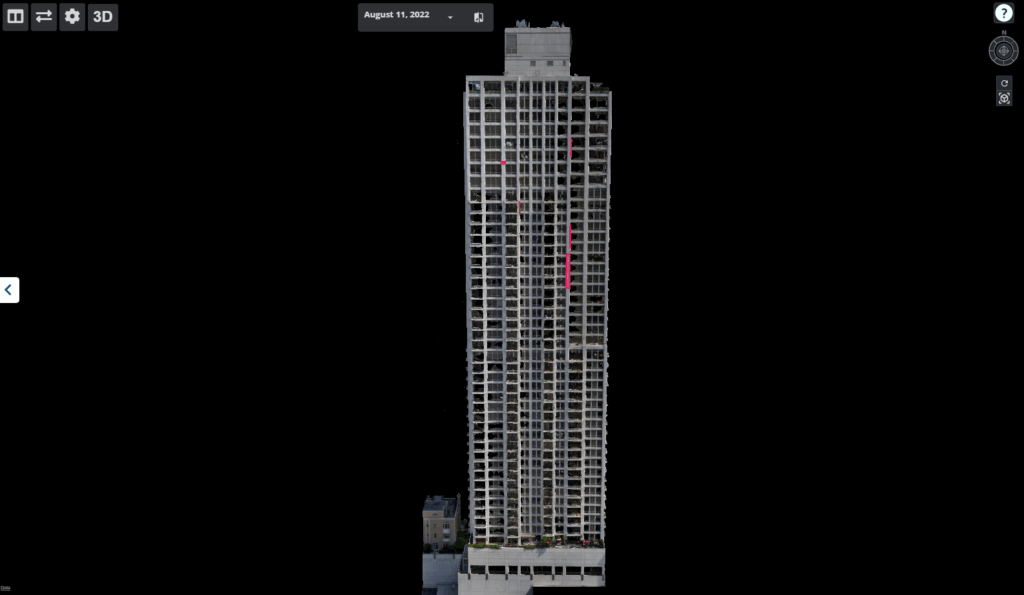
One of the biggest challenges in facilities management is that so much deterioration happens out of sight. Cracks form beneath surface coatings. Water infiltrates behind cladding. Pavement slowly shifts under the weight of vehicles and weather. Without the ability to see these changes as they unfold, damage often goes unnoticed until it’s an emergency.
That’s why tracking change over time is so critical, and why traditional inspections often fall short. Walkthroughs and manual condition reports provide moment-in-time snapshots, often relying on subjective observations that vary from one inspector to the next. But what’s needed is a consistent, visual record of how asset conditions evolve across seasons, years, and usage cycles.
Modern drone-based inspections fill this gap by capturing repeatable, high-resolution imagery from the same vantage points over time. When combined with AI-powered models trained to detect wear patterns — think membrane bubbling on a roof or spalling in concrete — these tools enable facilities teams to monitor deterioration before it disrupts operations.
For example, an aerial inspection might flag early signs of pooling water on a flat roof. Alone, that might not justify a major repair. But compare that image to one from six months prior, and it may reveal worsening drainage issues or membrane degradation. This temporal visibility helps teams prioritize action based not only on current condition but on how quickly that condition is changing.
In large facilities with high-cost elements like roofing, facades, and pavement, this ability to detect and visualize incremental wear can be the difference between a targeted repair and a six-figure replacement.
Smarter Roof and Facade Inspections: Protecting the Building Envelope
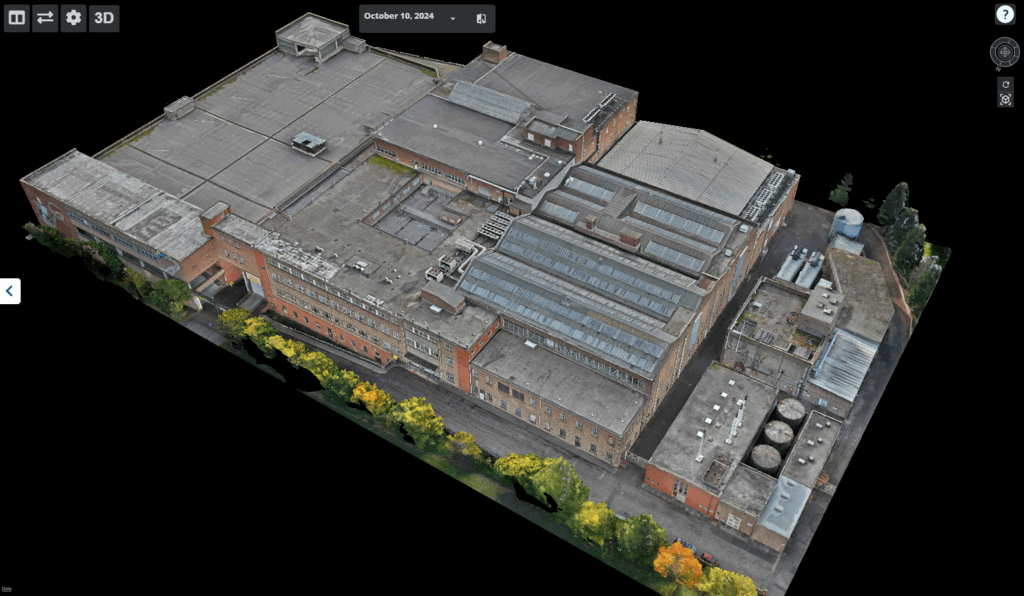
Routine commercial roof inspections are one of the most important investments in facilities management, particularly when you factor in how much unseen damage can develop over time. Leaks, membrane wear, and storm-related deterioration are all issues that can quietly erode asset value if not addressed early.
And the costs of deferred maintenance are substantial. Inspections and repairs done proactively — rather than only when issues arise — typically cost $0.14 per sq ft annually, compared to $0.25 per sq ft for reactive-only maintenance approaches. On a 100,000-square-foot property, that amounts to a difference of $11,000 per year in capital expenditures.
Roof inspection drones support and even enhance these cost savings by reducing labor, equipment, and access costs. Unlike traditional inspections, which often require scaffolding, lifts, or rope access teams, drones can be deployed in minutes with a single operator, eliminating much of the setup time and safety risk.
This makes it faster, safer, and more cost-effective to monitor roof conditions on a regular basis. High-resolution imagery and thermal scans from drone roof inspections can detect issues invisible to the naked eye, and all visual data can be centralized in facilities management software, enabling long-term tracking and faster detection of changes over time.
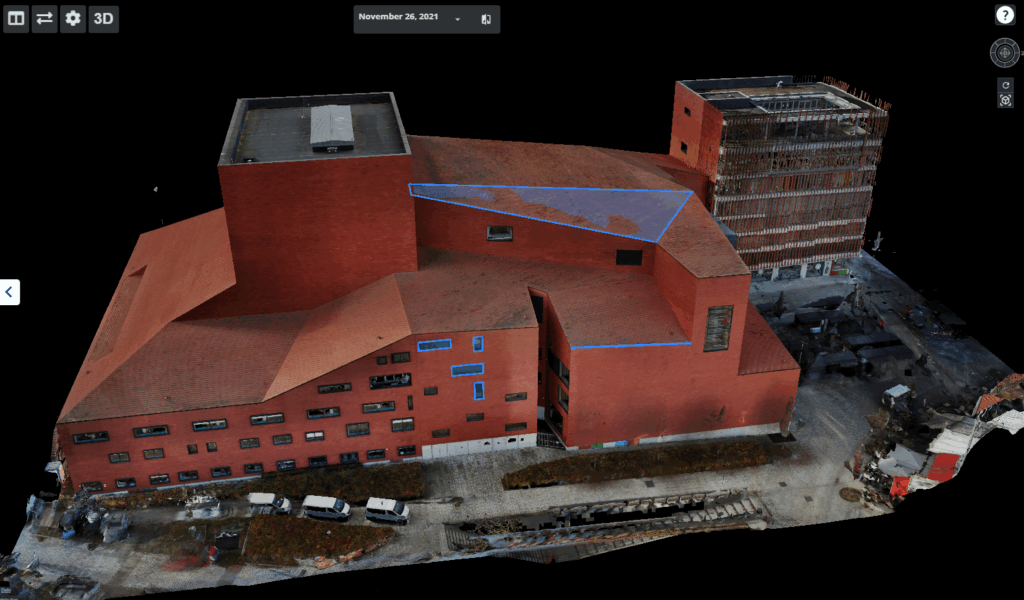
As any facilities manager knows, however, roofs aren’t the only vulnerable surface in the building envelope. Exterior facades are equally prone to weathering, structural shifts, and water infiltration, especially in aging buildings or those exposed to harsh climates. Consistent facade inspection using drone imaging or other building envelope testing methods can reveal cracking, staining, or spalling that may indicate deeper issues.
Adding building facade inspections to your standard inspection cycle makes it easier to prioritize facade maintenance before problems grow into serious capital expenditures. When you combine them with drone-based building envelope inspections, you gain a more complete picture of your facility’s exterior health. Ultimately, this helps you make smarter decisions about repairs vs. replacements and plan capital budgets more strategically.
Managing Stormwater Runoff and Drainage
After roofs and facades, one of the most critical components of a facility inspection is stormwater runoff management. Even if the building envelope is in good shape, poor drainage can undermine those investments by allowing water to infiltrate vulnerable areas or collect where it causes damage.
Unchecked runoff can accelerate wear on parking lots, walkways, and landscaped areas, while also contributing to foundation settlement, basement leaks, and mold growth inside the building. Over time, these issues increase maintenance workload — and they can trigger major, unplanned capital expenditures to replace structural components or resurface large paved areas.
Beyond preventing property damage, implementing poor stormwater runoff solutions can also open the door to compliance issues. Many facilities are subject to environmental regulations that prohibit polluted water from entering public storm drains, not to mention permit requirements for erosion control and site drainage. Standing water or improper grading can also violate local safety and health codes, adding liability risks to the burden of repair costs.
Regular inspections of stormwater drainage systems — including roof drains, gutters, downspouts, and surface grading — help identify blockages, erosion, or pooling before they become serious problems. Drone-based aerial surveys and high-resolution imaging can spot telltale signs like sediment buildup or water staining, giving facilities teams the visual evidence they need to prioritize repairs and other stormwater drainage solutions.
The bottom line? By catching small drainage issues early, managers can extend the life of paved surfaces and structural components while avoiding the sting of compliance violations or the financial shocks of emergency water damage.
Parking Lot Maintenance
Parking lots may seem secondary compared to the larger building envelope, but these expansive paved surfaces have an immediate impact on visitor experience. Hairline cracks, developing potholes, poor drainage, and fading striping all make parking lot navigation difficult or precarious. Even subtle surface changes can indicate underlying structural issues, and catching them early is far less costly than repairing advanced damage.
When routine commercial parking lot maintenance is delayed, small cracks can allow water to infiltrate the pavement base, accelerating deterioration from freeze–thaw cycles and weakening load-bearing capacity. Before long, this creates a need for full-depth resurfacing — an expensive, capital-intensive solution that can strain facilities’ budgets.
As with the rest of the building, using high-resolution aerial imagery or ground-based scanning to document changing parking lot conditions helps establish a visual history that makes degradation patterns easier to spot. This data can feed directly into facilities management software, allowing teams to forecast when they’ll need to plan preventive work like sealcoating, crack filling, or restriping.
Capital Planning and Decision-Making
With so many property components to maintain, facilities managers are constantly balancing urgent repair needs with long-term asset preservation. And without solid inspection data, those decisions often rely on guesswork. Better inspection data provides a clearer picture of asset condition, so teams can prioritize repairs that will truly extend service life while avoiding premature or unnecessary replacements.
Take commercial parking lots as an example. Routine preventive maintenance like sealcoating might cost $0.20–$0.50 per square foot, meaning a 50,000-square-foot lot can be treated for as little as $10,000. In contrast, full resurfacing runs $3–$7 per square foot — or $150,000 to $350,000 for the same lot. When degradation goes unnoticed, the cost difference can easily reach well into the six-figure range.
High-resolution aerial imagery and ground-based scanning ensure deterioration doesn’t fly under the radar. Such tools provide a year-over-year record of changes that feeds directly into capital management and planning models. With this data, facilities teams can:
- Forecast major expenses more accurately, building realistic budgets and avoiding surprises.
- Reduce unnecessary repairs by pinpointing which areas truly require intervention.
- Allocate resources strategically, directing funds to the highest-priority projects first.
In short, deploying change-over-time technology allows managers to shift from reactive spending to intentional, data-driven investment.
The Future of Facilities Management
As facilities teams look ahead, centralizing inspection data for all assets will be critical for supporting smarter capital planning. Housing this information in a single platform like gNext eliminates data silos and gives managers a holistic view of asset health.
Artificial intelligence is already playing a bigger role, turning raw inspection imagery into actionable forecasts that predict when repairs will be needed and which ones will deliver the greatest ROI. When paired with facilities management software, these insights allow organizations to plan capital projects with precision and avoid expensive surprises.
Ready to see how our platform brings these capabilities together? Book a demo today and discover how seamlessly gNext integrates with your existing systems to create a clearer, more confident path to proactive facilities management.


